

EcoLab
About the Laboratory
Coordinators: dr hab. Julia Fiedorczuk-Glinecka, dr hab. Gerardo Beltrán Cejudo
Interdisciplinary Ecopoetological Laboratory is conceived as a series of encounters with outstanding poets, artists and scholars whose creative and/or artistic activities engage the problematics of ecopoetics, understood broadly as a field of enquiry into human and non-human ways of worldmaking in the Anthropocene. Poetics is understood, in keeping with the definition proposed by Aristotle, as poiesis, that is to say, making through in-forming. It is precisely formal experimentation that interests us most, especially in so far as it responds to the challenges posed by the planetary crisis.The current crisis questions the received anthropocentric definitions of creativity, agency and sense. The aim of the Laboratory is to examine alternative, more adequate ways of articulating these issues which are beginning to emerge in contemporary science, art and, last but not least, poetry. We wish to build a platform for a creative exchange of ideas in the outlined area.
The Laboratory will host two guests each year of the project. So far our invitation has been accepted by Lynn Keller (University of Wisconsin-Madison), the Pulitzer-winning poet Forrest Gander (Brown University) and the poet-researcher Adam Dickinson (Brock University, Canada). Each visit will last from 1 to 2 weeks. During this time, the guests will give talks and conduct workshops for the scholars engaged in the Studies in Non-Anthropocentric Cultural Subjectivity project as well as for the faculty and students at Warsaw University. Poets will also give readings for a wider audience.
Lynn Keller (University of Wisconsin-Madison), 2021
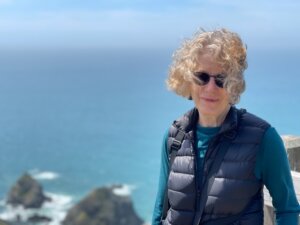
© Lynn Keller
Lynn Keller’s research interests include post-war American poetry, experimental poetics of recent decades as well as ecocriticism. Much of her work has focused on innovative writing by women. Her published books include: Forms of Expansion: Recent Long Poems by Women (University of Chicago Press, 1997), Thinking Poetry: Readings in Contemporary Women’s Exploratory Poetics (University of Iowa Press, 2010) and Recomposing Ecopoetics: North American Poetry of the Self-Conscious Anthropocene (University of Virginia Press, 2018). She declares: “While linguistically innovative work has been at the center of my research, I am committed to reading broadly in the field of contemporary poetry and to cultivating in my students the varied reading skills necessary to appreciate varied poetics.” In recent years, combining her interest in experimental poetry with her engagement in environmental issues, Keller has contributed significantly to the development of ecopoetics. Lynn Keller is a professor of poetry and environmental humanities at the University of Wisconsin-Madison.
On May 31st (18 CET) 2021 Lynn Keller gave a talk entitled: “Meditations in an Emergency: The Poetics of the Self-Conscious Anthropocene.” Watch the video.
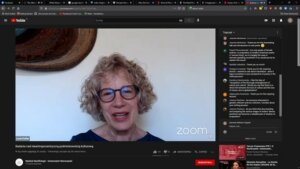
© Julia Fiedorczuk
Forrest Gander (Brown University), 2021
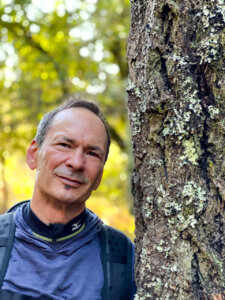
© Forrest Gander
Forrest Gander was born in California’s Mojave Desert, grew up in Virginia, studied geology and literature (San Francisco State University). Lived briefly in Mexico, then in Arkansas, where his poetry – informed by his knowledge of geology – turned its attention to the landscape as a source of action. After a period in Providence, Rhode Island (where he taught at Brown University) Gander moved back to California where he now resides.
Gander’s newly released book, Twice Alive (2021), addresses the exigencies of our historical moment and the intimacies, personal and environmental, that bind us to others and to the world. Be With (2018), winner of the Pulitzer Prize, was a lamentation for the poet’s deceased wife the poet C. D. Wright. Core Samples from the World (2011) – collaboration studded with the work of three great photographers, Graciela Iturbide, Raymond Meeks, and Lucas Foglia—was a finalist for the Pulitzer Prize and the National Book Critics Circle Award. Gander’s other collections include Eye Against Eye, with photographs by Sally Mann; Torn Awake; and Science & Steepleflower.
Gander is also a highly esteemed translator from he Spanish, a novelist, an essayist, and an editor of poetry anthologies. He has translated mostly Mexican women poets (Pura López Colomé, Coral Bracho) but also the Bolivian author Jaime Saenz’s and Pablo Neruda.
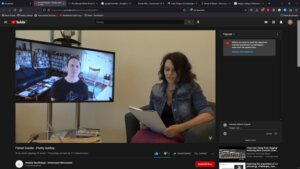
On June 7th (18 CET) 2021 Gander read from his work and took questions from the public. The meeting was moderated by Julia Fiedorczuk-Glinecka. Watch the video.
© Julia Fiedorczuk-Glinecka
Yásnaya Aguilar, 2022
In the territory of what is now known as Mexico, 68 languages are spoken in addition to Spanish. All 68 are recognised as official languages, but their situation is very different from the dominant Spanish. Counteracting the hegemony of a single, colonial language is an urgent task: the ongoing eradication of linguistic diversity destroys indigenous cultures and accelerates environmental destruction. We have invited two outstanding poets and activists, Yásnaya Aguilar and Martín Tonalmeyotl, to discuss the situation of indigenous languages of Mexico, and to reflect on these languages’ potential to question the anthropocentrism of mainstream western thinking, the discussion helped to expose the limits of western environmentalism.
© Yásnaya Aguilar
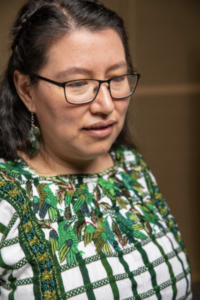
Yásnaya Aguilar (1981), born in Ayutla Mixe in the state of Oaxaca, is a linguist, writer, translator and researcher. She is also an activist for linguistic rights and an environmental activist. Her mother tongue is Ayuujk (or Mixe), belonging to the Mixe-Zoque linguistic family. Mixe has six linguistic variants and is spoken by over 130,000 people in the state of Oaxaca.
Martín Tonalmeyotl, 2022
In the territory of what is now known as Mexico, 68 languages are spoken in addition to Spanish. All 68 are recognised as official languages, but their situation is very different from the dominant Spanish. Counteracting the hegemony of a single, colonial language is an urgent task: the ongoing eradication of linguistic diversity destroys indigenous cultures and accelerates environmental destruction. We have invited two outstanding poets and activists, Yásnaya Aguilar and Martín Tonalmeyotl, to discuss the situation of indigenous languages of Mexico, and to reflect on these languages’ potential to question the anthropocentrism of mainstream western thinking, the discussion helped to expose the limits of western environmentalism.
© Martín Tonalmeyotl
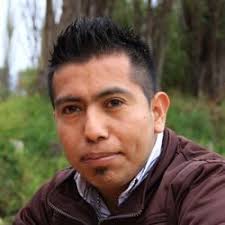
Martín Tonalmeyotl (Martín Jacinto Meza, b. 1983) is a Nahua poet, narrator, translator and photographer originally from Atzacoaloya de Chilapa de Álvarez, in the state of Guerrero.
Tonalmeyotl studied Hispano-American Literature at the Autonomous University of Guerrero and Linguistics at the Center for Research and Higher Studies in Social Anthropology. He is currently a doctoral student at the Autonomous University of Puebla, while working as a farmer and a Nahuatl language teacher. His poems, stories, articles and photographs have been published internationally in print and digital media. He is the author of several books of poetry, including Tlalkatsajtsilistle/Ritual de los olvidados (2016) and Istitsin ueyeatsintle/Uña mar (2019). Tonalmeyotl has also served as an editor of several anthologies of poetry in indigenous languages, including: Xochitlajtoli: Contemporary Poetry in Native Languages of Mexico [32 poets from 16 languages] (2019) and Flor de siete pátalos [seven Mexican women poets from seven languages] (2019).
Issue of the literary magazine “Wizje” devoted to EcoLab (02.2022)
A new issue of the online literary magazine Wizje has just been published, with a special part devoted to the Ecopoetological Laboratory. We invite you to read the texts of the former and future guests of the EcoLab: Forrest Gander, Adam Dickinson (with whom we will meet live in Warsaw in less than two weeks, 23 May 2022), Esther Kinsky, Brenda Hillman, Zoë Skoulding and Yásnaya Aguilar. Polish translations were made by members and friends of our project.
Forrest Gander (Brown University), 2022
© Forrest Gander
Forrest Gander was born in California’s Mojave Desert, grew up in Virginia, studied geology and literature (San Francisco State University). Lived briefly in Mexico, then in Arkansas, where his poetry – informed by his knowledge of geology – turned its attention to the landscape as a source of action. After a period in Providence, Rhode Island (where he taught at Brown University) Gander moved back to California where he now resides.
Gander’s newly released book, Twice Alive (2021), addresses the exigencies of our historical moment and the intimacies, personal and environmental, that bind us to others and to the world. Be With (2018), winner of the Pulitzer Prize, was a lamentation for the poet’s deceased wife the poet C. D. Wright. Core Samples from the World (2011) – collaboration studded with the work of three great photographers, Graciela Iturbide, Raymond Meeks, and Lucas Foglia—was a finalist for the Pulitzer Prize and the National Book Critics Circle Award. Gander’s other collections include Eye Against Eye, with photographs by Sally Mann; Torn Awake; and Science & Steepleflower.
Gander is also a highly esteemed translator from he Spanish, a novelist, an essayist, and an editor of poetry anthologies. He has translated mostly Mexican women poets (Pura López Colomé, Coral Bracho) but also the Bolivian author Jaime Saenz’s and Pablo Neruda.
On May 20th (18 CET) 2022 Gander read from his work and took questions from the public. The meeting was moderated by Julia Fiedorczuk-Glinecka. Watch the video.
Adam Dickinson (Brock University, Canada), 2022
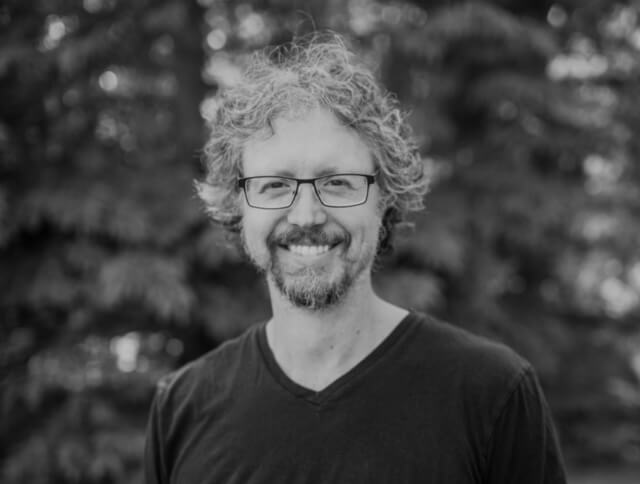
In May 2022 the Eco Lab hosted a visit by an internationally-renowned poet and researcher Adam Dickinson. A literature and creative writing professor at Brock University, Canada, Dickinson is the author of four books of poetry, the latest of which, Anatomic (Coach House Books), won the Alanna Bondar Memorial Book Prize from the Association for Literature, Environment, and Culture in Canada.
Anatomic is a radically transdisciplinary work, involving the results of chemical and microbial testing on the poet’s body, used as a starting point for a poetic reflection on how „the outside writes the inside” in the Anthropocene. This experiment in science and poetics was at the center of an artist’s talk titled THE WORK OF ART: METABOLISM, ECOPOETICS, AND THE LABORATORY delivered by the poet on May 23rd at the Department of Modern Languages, University of Warsaw. The lecture articulated what the author refers to as „metabolic poetics”, addressing the circulation of energies, substances and meanings in an individual body as well as in the globalized world. The recording of the talk can be watched on our youtube channel.
© Adam Dickinson
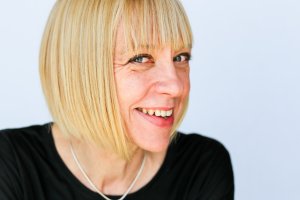
Zoë Skoulding (University of Bangor, Wales), 2023
In May 2023 the Eco Lab hosted a visit by a poet and scholar Zoë Skoulding. A literature and creative writing professor at the University of Bangor, Wales, Skoulding is the author of seven books of poetry, including A Marginal Sea (2021) and Footnotes to Water (2019), which was a Poetry Book Society Recommendation and won the Wales Book of the Year Poetry Award 2020. Her critical work includes two monographs, Contemporary Women’s Poetry and Urban Space: Experimental Cities (2013), and Poetry & Listening: The Noise of Lyric (2020).
Zoë Skoulding is interested in translation, sound and ecology. Her exploratory work, inspired by European and American avant-garde traditions as well as by feminist poetics, is both lyrical and experimental, playful and seriously engaged. During her visit, prof. Skoulding gave a talk titled „Resounding bodies: ecopoetics, listening and translation” in which she reflected on how experimental practices of poetry and translation can enable different kinds of listening – and therefore new kinds of community – across the boundaries of languages, species, and forms of knowledge. The recording of the lecture can be watched on our youtube chanel.
In subsequent days prof. Zoë Skoulding conducted a workshop for the members of the Non-Anthropocentric Cultural Subjectivity research team and read for her Polish fans at the International Poetry Festival Silesius in Wrocław. During the workshop we discussed her essay „All the birds had called a conference”: Songs of the Emergency, soon to be published in the volume: Places that the Map Can’t Contain: Poetics in the Anthropocene (edited by Julia Fiedorczuk and Paweł Piszczatowski).
This year’s Eco Lab’s special attraction was an early morning urban birdwatching walk led by prof. Przemysław Chylarecki (Polish Academy of Sciences).
© Zoë Skoulding
Anne Pringle (University of Wisconsin, Madison) and Forrest Gander (Brown University), 2023
On 26th October 2023 prof. Anne Pringle and prof. Forrest Gander gave an open lecture „The Persistence of Dispersed Worlds”: On the (Im)possibility of Alliance between Poetry and Science, trying to answer questions such as: Is there an ethics of description? Are poetic and scientific modes of description at odds with each other?
Biologist Anne Pringle and writer Forrest Gander consider their collaborative work, the nature of death, immortality, and the organism (including the self) as a community.
Forrest Gander is a writer and translator with degrees in geology and literature, born in the Mojave Desert and taught at Harvard and Brown Universities. His books, often concerned with ecology, include Be With, winner of the Pulitzer Prize and Twice Alive both translated into Polish by Julia Fiedorczuk. Gander’s translations include Alice Iris Red Horse: Poems by Gozo Yoshimasu and Then Come Back: the Lost Neruda Poems. Often collaborating with artists such as Ann Hamilton, Sally Mann, Graciela Iturbide, and Vic Chesnutt, Gander has written extensively about the environment and, in A Faithful Existence, the relation between science and literature.
Anne Pringle earned her Ph.D. in Botany and Genetics at Duke University. After completing a Miller Institute for Basic Research in Science Fellowship at the University of California, Berkeley, she joined the faculty at Harvard University. She next moved to the University of Wisconsin, Madison, where she is now Vilas Distinguished Achievement Professor in the Departments of Botany and Bacteriology. Pringle has given over 100 invited talks to academic and popular audiences in countries including China, Colombia, France, Singapore, Sweden, Thailand, and the United States. She has been awarded the Alexopoulos Prize for a Distinguished Early Career Mycologist (2010), the Mendelsohn Excellence in Mentoring Award from the Harvard University Graduate Student Council (2011), the Fannie Cox Prize for Excellence in Science Teaching from Harvard University (2013), and a Radcliffe Institute for Advanced Study Fellowship (2011–2012). Her research has been featured by the New York Times, National Public Radio, Slate, and the Wisconsin State Journal, among others. In 2019, Pringle was elected President of the Mycological Society of America.
Publication of the book “Places that map can’t contain”, 2023
In July 2023 the book “Places that map can’t contain”: Poetics of the Anthropocene had an official premiere. The publication was prepared by scholars involved in the EcoLab: Julia Fiedorczuk and Paweł Piszczatowski (as editors, authors of the introduction and individual chapters) but also Gerardo Beltrán and Grzegorz Czemiel amongst the contributors.
Inspired by Lynn Keller’s notion of “the self-conscious Anthropocene,” the book sets out to consider poetry as a privileged space for rethinking our basic epistemological assumptions. Poetry does not have the kind of agency a direct political intervention has; in fact, as W. H. Auden famously put it, “poetry makes nothing happen.” On the other hand, poetry is crucial when it comes to awakening our individual and collective imagination. Considering the statement by Lawrence Buell that the current ecological crisis is, in the first place, a crisis of the imagination, this function of poetry comes through as particularly important.
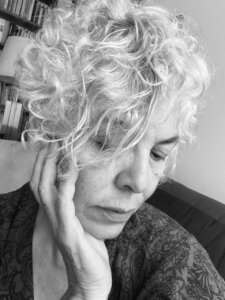
María Baranda (Mexico), 2024
On 15th April 2024 María Baranda, hosted by the Ecopoetelogical Laboratory in Warsaw, gave a lecture in Modern Languages Department, entitled Un Bosque de Tinta, moderated by Gerardo Beltrán. The recording of the talk can be watched here.
María Baranda was born in Mexico City in 1962. She has received several awards, including the Aguascalientes National Poetry Prize in 2003, the Sabines-Gatien Lapointe Prize in Canada in 2015, and the Ramón López Velarde International Poetry Prize in 2018. Yale University recently published The New World Written: Selected Poems, and Edizioni Fili dÁquilone published her book Teoria delle Bambine in Italian. Her poetry has been translated into several languages, including Chinese, French, English, Lithuanian, German, and Italian. As a translator, she has just published, together with Paul Hoover, the Complete Poetry of St. John of the Cross in English with Milkweed Editions, 2021.
Some of her books are: Narrar, Atlántica y El Rústico, Ávido mundo, Arcadia, Ficticia, Teoría de las niñas, and the most recent Sombra y Materia.
On 20th April, María Baranda and Juana Adcock took part in Poezja w Puszczy Festival in Białowieża Forest. They both read their poems during the poetry walk in the woods and in the evening – held meetings and discussion on Mexican culture, translation and works of Hubert Matiúwàa who joined the conversation virtually.
© María Baranda
“Poetics in the Anthropocene” – Conference, 2024
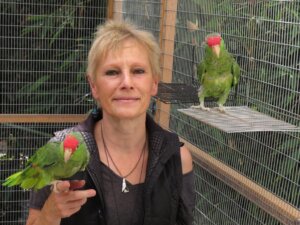
Ursula K. Heise (UCLA), 2024
In November 2024 Ursula K. Heise was hosted by Eco Lab. During her stay in Warsaw, prof. Heise conducted a workshop around her text „The Hitchiker’s Guide to Ecocriticism” for researchers of Environental Humanities Center and gave a lecture open to all students entitled “Multispecies Justice and Narrative” (November 18th).
Heise has also a chance to attend an early morning urban birdwatching walk led by Stanisław Łubieński along the Vistula River.
Ursula K. Heise holds the Marcia H. Howard Term Chair in Literary Studies in the Department of English and the Institute of the Environment and Sustainability at UCLA. She is co-founder and current Director of the Lab for Environmental Narrative Strategies (LENS). Her research and teaching focus on the environmental humanities; contemporary environmental literature, arts, and cultures in the Americas, Germany, Japan, Spain, and Vietnam; literature and science; science fiction; and narrative theory. Her books include, among others, Sense of Place and Sense of Planet: The Environmental Imagination of the Global (Oxford University Press, 2008) and Imagining Extinction: The Cultural Meanings of Endangered Species (University of Chicago Press, 2016), which won the 2017 book prize of the British Society for Literature and Science. She is co-editor of The Routledge Companion to the Environmental Humanities (Routledge, 2017), and co-editor of the series Literatures, Cultures, and the Environment with Palgrave. She is also producer and writer of Urban Ark Los Angeles, a documentary on urban parrots created as a collaboration of LENS with the public television station KCET-Link. Her most recent book, a co-edited essay collection on Environment and Narrative in Vietnam, was published in 2023. She is currently at work on a book entitled Reclaiming Ecotopia: Science Fiction and Environmental Futures.
© Ursula K. Heise
1st Edition of the Serbian School of Ecopoetics, 2024
The first, three-day Ecopoetics School at the Belgrade Cultural Center took place in December 2024 and was organized in cooperation with the Polish Institute in Belgrade and the Adam Mickiewicz Institute from Warsaw, was a pioneering undertaking that opened up an opportunity for a special encounter with different aspects of environmental humanities. The intersection of theory and practice lead to inspiring perspectives that can offer new answers to the pressing challenges of modernity. During the first day of the school the associates from Serbia gave presentation on topics such as ecoaesthetics, folklore or human-animal anthropology, while during the second day the time was reserved for guests from Poland. Polish contribution was dedicated to the concepts of wilderness and the so-called untouched nature in the context of ecopoetics and ecocriticism. Both days were concluded with poetry evenings, when literary contributions illustrating ecopoetic concepts were presenting their work and reading poetry by authors such as Gary Snyder, Natalie Diaz or Forest Gander. On the last, third day, a walking and creative workshop was organized in the immediate vicinity of the Belgrade Cultural Center. All parts of the programme were open to the public.
Contributors/lecturers: Uroš Đurković, Andrija Filipović, Ivan Praštalo, Sonja Žakula, Julia Fiedorczuk, Maciej Rosiński, Michalina Czerwońska
Poets: Tijana Savatić, Jelena Žugić, Vuk Vučković, Uroš Mikić, Marko Stalevski, Julia Fiedorczuk
The first Serbian ecopoetics publication List was presented during the presentations on the first and second days of the School of Ecopoetics. Between the covers of the first List there is a general overview of ecological humanities, then an interview with Julia Fiedorczuk, conducted by Jelena Nidžović, as well as an excerpt from the study Cyborg in the Garden by Julia Fiedorczuk. The issue closes with Andrija Filipović’s contribution on the Anthropocene and Ecoaesthetics. The editors of the publication are Jelena Nidžović and Uroš Đurković.
Polish-Ukrainian EcoLab, 2024
On December 16th, 2024, thanks to Adam Mickiewicz Institute in Warsaw and Frontera we organized an on-line edition of EcoLab, together with Ukrainian scholars. During the 4 hour event, we talked, discussed and shared our views on situated, ecopoetological contexts. The event began with Julia Fiedorczuk’s talk on ecopoetics and was followed by Bohdan Kuchenko’s talk on the influence of war on natural environment in Ukraine. Then, the participants took part in a literary workshop and discussion held by Michalina Czerwońska and Zuzanna Legan around texts by Ursula K. Heise and Tamara Hundorova. The evening was concluded with a poetry reading by great, international set of poets: Adam Dickinson, Ilya Kaminski, Forrest Gander, Iryna Szuwałowa, Julia Fiedorczuk, Bartłomiej Majzel and Ostap Sływynski.
Ecopoetics is a space for thought on human and nonhuman ways of co-creation of the world in the Anthropocene. The entangled planetary conflicts (ecological catastrophe, loss of biodiversity, deforestation, social inequalities and wars) are challenging the imagination, putting into question all the existing ways of speaking about the world. The aim of the EcoLab was to reflect on cultural texts that are focused on rebuilding relations between humans and environments. The current wars not only cause harm to people but also degrade the enire ecosystems. During the meeting, we tried to find ways of speaking about the influence war has on environment and how we can include Ukrainian ecocrtical studies in international debates.
2nd Edition of the Serbian School of Ecopoetics, 2025
Between 20 and 24th March 2024 the second edition of Serbian School of Ecopoetics took place in Kulturni centar Beograda, Belgrade, Serbia. It was a workshop-style event, taking place as part of the activities programmed by the poet prof. Julia Fiedorczuk, whose mission is to create and strengthen deep ecological competences in the School’s listeners, which will translate into their creative and professional practices.
During the workshops, participants read and analysed selected ecocritical texts and poems, took part in literary lectures as well as field trips aimed at deepening the participants’ bonds with their bioregion.
In the context of technological changes in recent decades – especially digitisation – the economy of human attention is also changing. This is a process so disturbing that philosophers, ecologists, but also representatives of neuroscience are calling for us to rethink our relationship with technologies. The average level of intelligence in modern societies is already measurable, the space of sensory experience available to people is shrinking, and the bond with the natural environment is undergoing complete atrophy. During the congress, participants looked at this problem from a number of different perspectives, but throughout this journey they were guided by poems (by Polish and international authors). It is no coincidence that the second congress of the School was taking place at the same time as International Poetry Day and the accompanying poetry festival Off the yielding marshlands • World Poetry Days.
Poets: Anja Marković, Dragana Mladenović, Ivan Isailović, Maša Seničić, Nenad Stanković, Ognjen Aksentijević, Petar Matović, and Tanja Stupar Trifunović and authors gathered around the second cycle of the School of Ecopoetics, international guests of the SDP: Bartłomej Majzel, Emilia Konwerska, Stanisław Kalina Jaglarz, Gregoire Suris, Juana Adcock, and Julia Fiedorczuk.
Partners: Kulturni Centar Beograda (Cultural Centre of Belgrade), Polish Institute in Belgrade, Adam Mickiewicz Institute
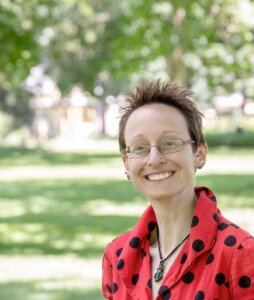
Orchid Tierney (Kenyon College), 2025
In May 2025 the Eco Lab hosted a visit by the poet and scholar Orchid Tierney from Aoteora-New Zealand, now residing in Ohio, USA.
During her visit, prof. Tierney conducted a workshop (May 5th) for the members of the Non-Anthropocentric Cultural Subjectivity research team in Modern Languages Department. The workshop was centered around her essay that was part of the book Routledge Companion to Ecopoetics, titled „Anti-atmospheres and Everyday Rare Phenomena”. On May 7th she gave an open lecture Buoyant Ecologies: Bubbles and Fluid Mobilities in Keri Hulme’s “Floating Words” about cyclical forms of Indigenous agency, language sovereignty, and futurities that resist the enclosures and world-endings of settler apocalyptic narratives. On May 9th, together with Julia Fiedorczuk, Grzegorz Czemiel, Paweł Piszczatowski and other scholars and artists, Orchid Tierney joined the Poezja w Puszczy Festival in Białowieża Forest and had a chance to read her poems there.
Orchid Tierney is the author of this abattoir is a college (Calamari Archive, 2025) and a year of misreading the wildcats (The Operating System, 2019) as well as several chapbooks, including looking at the Tiny: Mad lichen on the surfaces of reading (Essay Press, 2023), my beatrice (above/ground press, 2020), ocean plastic (BlazeVOX Books, 2019), and blue doors (Belladonna* Press, 2018). Tierney is the co-editor of the Routledge Companion to Ecopoetics (2023) and her scholarship has appeared in Venti, SubStance, Jacket2, The Cambridge Companion to Australian Poetry, Teaching the Literature of Climate Change, and The Cambridge Companion to American Poetry and Politics Since 1900. She is an assistant professor of English at Kenyon College and a senior editor at the Kenyon Review. Orchid is also a Black Earth Institute Fellow for 2022–2025 and the co-director of the Science and Nature Writing Initiative at Kenyon College.
© Orchid Tierney
EcoLab 2.0 in Ukraine, 2025
On May 14–15, 2025 the second edition of EcoLab 2.0 took place in Lutsk, Ukraine – this time as part of the Frontera literary and cultural festival. What began in a bomb shelter turned into two days of workshops, performances, and deep conversations about art, ecology, war, and the uncertain shape of the future.
Poets and scholars Julia Fiedorczuk and joined Ukrainian artists, writers, and activists to explore what ecopoetics can mean in times of crisis. Their presence wasn’t simply academic – it was an act of solidarity and co-creation in a place where the stakes of cultural and environmental work are immediate and real.
“Ukraine was not just the setting of this EcoLab – it was the protagonist. We met people who live and think in days and weeks, and yet what they do slowly polishes the shards of broken glass. That’s how the future emerges – imperfect, but livable.” – Julia Fiedorczuk
“EcoLab in Ukraine transformed my understanding of ecocriticism. Here, ecology, literature, and decolonization are not theoretical concepts – they’re survival practices.” – Adam Dickinson
EcoLab 2.0 was made possible thanks to: the Frontera Literary Platform, British Council’s “Support for Cultural Activities in Ukraine”, Adam Mickiewicz Institute, Environmental Humanities Centre (University of Warsaw), PEN Català, and the NGO platform “Algorithm of Action”.
Adam Dickinson (Brock University, Canada), 2025
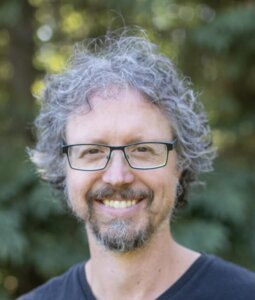
In May 2025 EcoLab hosted Adam Dickinson. The visit started in Lutsk, where the poet, together with Julia Fiedorczuk, attended the Ukrainian EcoLab 2.0, conducting workshops, participating in meetings and reading their poetry in front of Ukrainian audience. Then, prof. Dickinson and prof. Fiedorczuk came to Warsaw were they had a chance to finalize the work around the EcoLab film, presenting the idea behind the project and documenting the Polish-Ukrainian-Canadian edition of EcoLab.
During the stay in Warsaw, the members of the Non-Anthropocentric Cultural Subjectivity research team had a chance to participate in a meeting where Adam Dickinson read parts of his book Anatomic and Michalina Czerwońska – her translation of the poems. The paricipants were asked before to prepare an answer for Umwelt exercise. The readings were followed by the discussion on the poetry and prepared answers.
As a part of the visit, prof. Dickinson and some of EcoLab’s coordinators participated in an early morning birdwalk led by prof. Przemysław Chylarecki (Polish Academy of Sciences).
© Adam Dickinson
EcoLab Film, 2025
Juana Adcock, 2025
On October 16th, 2025 the EcoLab hosted the author Juana Adcock. The meeting with a Mexican-Scottish poet and translator was centered around her acclaimed new poetry collection, I Sugar the Bones that explored themes of translation, migration, and transcultural experience. She was joined by Gerardo Beltrán, Mexican poet and translator, and Dominika Lewandowska-Rodak, translator and scholar of Scottish literature, both from the University of Warsaw. The panelists talked about the different kind of borders: the ones between cultures and languages and the physical ones like the expanding wall on the USA-Mexico border. The conversation was moderated by Grzegorz Czemiel and followed by an open discussion with the audience.
Juana Adcock is the author of five poetry collections, including I Sugar the Bones (Out-Spoken Press, 2024), shortlisted for the 2025 Forward Prize for Best Collection. She co-edited Temporary Archives: Poetry by Women of Latin America (Arc, 2022) and has translated Translation of the Route by Laura Wittner (Bloodaxe/PTC, 2024) and The Dogs Dreamt by Hubert Matiúwàa, both winners of PEN Translates awards. Her work has been performed at literary festivals across Europe, Asia, and Latin America.

© Juana Adcock